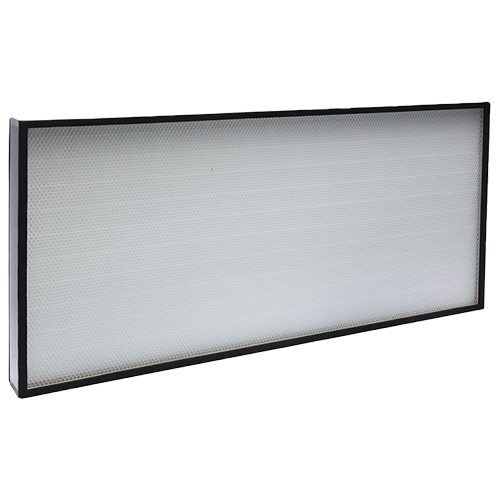
1. What are HEPA / ULPA filters?
A: 什么是HEPA/ULPA过滤器?
Please provide the text you would like me to translate.HEPA (High Efficiency Particulate Air) filters and ULPA (Ultra-Low Penetration Air) filters are used in cleanrooms to remove fine particles from the air. HEPA typically filters ≥0.3 μm particles with ≥99.97% efficiency, while ULPA achieves ≥99.999% for particles ≥0.12 μm.
Answer:HEPA (High Efficiency Particulate Air) and ULPA (Ultra Low Penetration Air) are mainly used in clean rooms to remove tiny particles from the air. HEPA has a filtration efficiency of ≥99.97% for particles ≥0.3 microns, while ULPA has a filtration efficiency of ≥99.999% for particles ≥0.12 microns.
2. Common applications of high-efficiency filters?
Q: Where are HEPA/ULPA filters commonly used?
Please provide the text you would like me to translate.They are widely used in cleanrooms for electronics, semiconductors, pharmaceuticals, biotechnology, medical, food industries, and in FFUs, clean benches, and terminal boxes.
Answer:HEPA/ULPA filters are widely used in industries such as electronics, semiconductors, pharmaceuticals, biotechnology, healthcare, and food, as well as in equipment such as FFU, ultra-clean workstations, and terminal air supply outlets.
3. What are the installation methods for high-efficiency filters?
Q: What installation methods are available for HEPA/ULPA filters?
Please provide the text you would like me to translate.Common types include separator type, mini-pleat type, and gel-seal type filters. They can be installed in ceiling grids, FFUs, or directly into cleanroom terminal housings.
Answer:Common types include partitioned, non-partitioned (foldable), and liquid seal type filters. Installation methods include embedding in ceiling grids, installing inside FFU, or directly installing at the cleanroom's terminal air supply.
4. How often should the high-efficiency filter be replaced?
Q: How often should HEPA/ULPA filters be replaced?
Please provide the text you would like me to translate.Typically every 1–3 years, depending on the environment and pressure drop across the filter. Differential pressure gauges are often used to determine the right replacement time.
Answer:Generally 1–3 years, depending on the cleanliness of the environment and the pressure difference across the filter. Usually used in conjunction with a pressure differential gauge to determine the best replacement time.
5. Can the high-efficiency filter be cleaned or reused?
Q: Can HEPA/ULPA filters be washed or reused?
Please provide the text you would like me to translate.No, they are not washable. Once the filter reaches its final resistance or efficiency drops, it must be replaced.
Answer:Cannot be washed and reused. When the filter reaches the final resistance or efficiency decreases, it must be replaced.
6. What are the common sizes of high-efficiency filters?
Q: What are the common sizes of HEPA/ULPA filters?
Please provide the text you would like me to translate.Standard sizes are 610×610mm, 610×1220mm, 305×610mm, and others. Custom sizes are also available upon request.
Answer:Common sizes include 610×610mm, 610×1220mm, 305×610mm, etc., and can also be customized according to customer requirements.
7. What are the detection methods for high-efficiency filters?
Q: How are HEPA/ULPA filters tested?
Please provide the text you would like me to translate.They are tested using DOP/PAO aerosol leak testing methods to ensure no leakage and proper sealing.
Answer:Commonly used DOP/PAO aerosol leak detection methods are employed to ensure there are no leaks and that sealing is good.
8. What are the frame materials of high-efficiency filters?
Q: What frame materials are used for HEPA/ULPA filters?
Please provide the text you would like me to translate.Common frame materials include galvanized steel, aluminum alloy, stainless steel, and MDF (Medium Density Fiberboard).
Answer:Common frame materials include galvanized steel, aluminum alloy, stainless steel, and medium-density fiberboard (MDF).